
Commercial washer operating cost is the number most buyers never calculate, and it’s usually the biggest one. Over a machine’s working life, electricity, water, sewer charges and maintenance typically add up to far more than the purchase price. That makes efficiency one of the most important and most overlooked factors when you choose equipment.
This guide breaks down what actually drives commercial washer operating cost, how to estimate it for your own laundry room, and what you can do to bring it down.
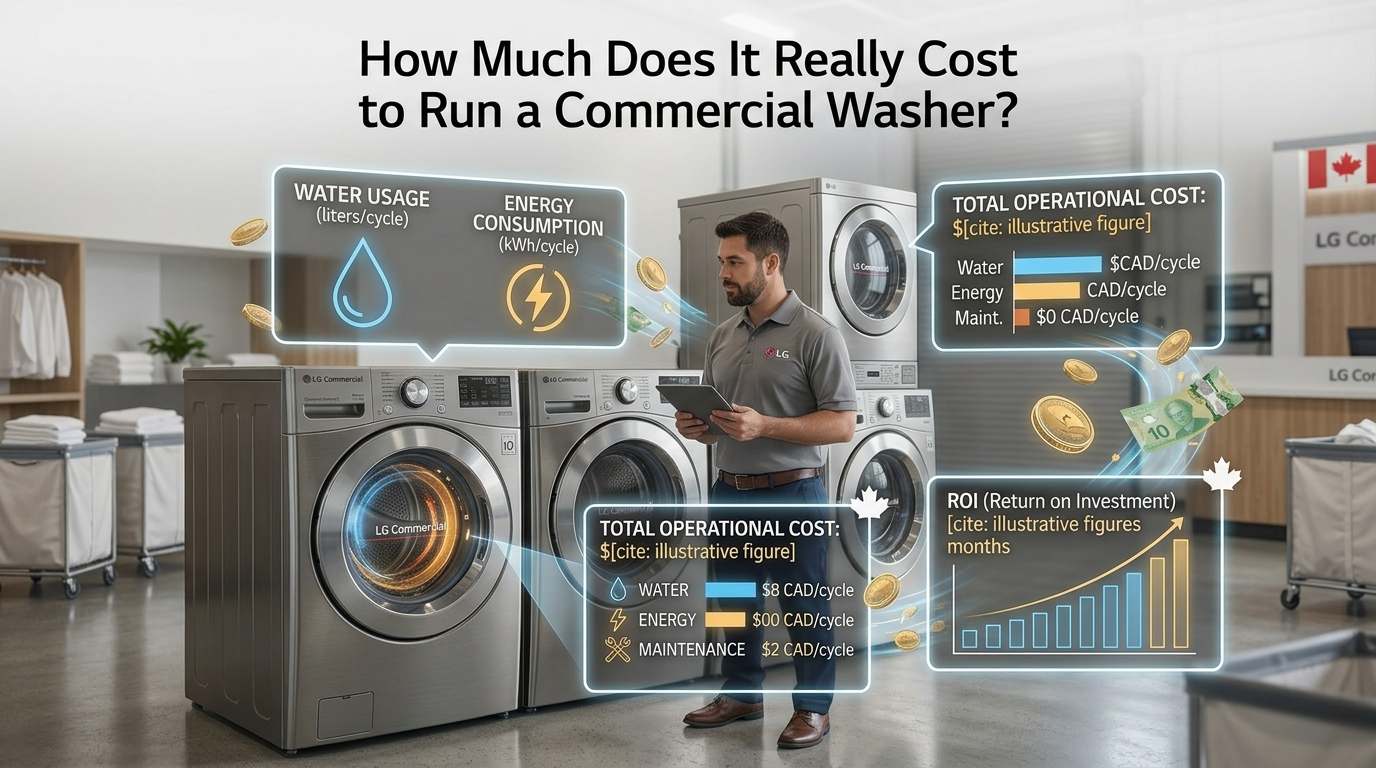
What Drives Commercial Washer Operating Cost
Electricity
Commercial washer energy cost starts with electricity, which powers the motor, the control electronics and, on hot cycles, any water heating done inside the machine. The motor design matters here: a direct-drive motor with no belt or pulley wastes less energy as friction than a conventional belt-driven setup.
Water and Sewer
Water is often underestimated. In many municipalities the combined water and sewer charge per cycle rivals the electricity cost, especially on hot washes where you pay for the water and then pay again to heat it. Machines that sense the load and fill accordingly avoid wasting water on smaller loads.
Maintenance and Downtime
Maintenance is the least predictable part of commercial washer operating cost. Repairs and parts are only part of it. The larger cost is often the revenue or service you lose while a machine is out. Maintenance follows a predictable pattern: minimal in the early years, more frequent wear-part replacement mid-life (door locks, seals, pumps), and rising repair frequency late in life.
Cycle count multiplies all three. A laundromat or hotel running dozens of cycles a day will see small per-cycle differences compound into large annual numbers.
How to Estimate Your Commercial Washer Operating Cost
You don’t need a spreadsheet to get a useful number. Use this formula with your own utility rates and the figures from the model’s spec sheet:
- Cycles per month = average cycles per day × days you operate.
- Energy cost per cycle = kWh per cycle × your electricity rate.
- Water cost per cycle = litres per cycle × your combined water and sewer rate.
- Monthly running cost = cycles per month × (energy cost + water cost per cycle).
- Add a maintenance reserve for parts, service calls and expected downtime.
Run the same calculation for two or three candidate machines. The one with the lowest purchase price rarely has the lowest total cost.
Example: Comparing Commercial Washer Operating Cost for Two Machines
The figures below are hypothetical and chosen only to show how the formula works. They are not LG specifications, so replace them with your own utility rates and the numbers from the spec sheet of each model. Assume 30 cycles a day over 30 days (900 cycles a month), electricity at $0.12 per kWh, and water plus sewer at $0.004 per litre.
| Machine A | Machine B | |
|---|---|---|
| Energy per cycle | 1.0 kWh | 0.8 kWh |
| Water per cycle | 100 litres | 70 litres |
| Running cost per cycle | $0.52 | $0.38 |
| Running cost per month (900 cycles) | $468 | $338 |
| Running cost per year | $5,616 | $4,061 |
Even this modest gap in commercial washer operating cost adds up to roughly $1,555 a year, before you count a single repair. If Machine B costs more to buy, the extra purchase price is often recovered through lower running costs.
What an ENERGY STAR Commercial Washer Rating Means for Operating Cost
ENERGY STAR-certified commercial washers are rated on both energy and water use. A higher Modified Energy Factor (MEF) means more laundry processed per unit of energy, and a lower Integrated Water Factor (IWF) means less water used per load. You can review the program requirements on the ENERGY STAR commercial clothes washers page. For Canadian laundromats and multi-housing laundry rooms, Natural Resources Canada explains how the program applies to pay-for-use clothes washers. When you compare an ENERGY STAR commercial washer against a standard model, check whether the specific one you’re considering is certified.
Technology That Lowers Commercial Washer Operating Cost
Several design choices reduce commercial washer energy cost and water use at the same time, and they add up over thousands of cycles.
- Inverter Direct Drive motor. Fewer moving parts means less friction loss and fewer wear items to replace.
- Efficient drain pump. Brushless pumps move water efficiently and run quieter than conventional ones.
- Load-based water level. Filling to the actual load avoids paying for water you don’t need.
- Serviceable design. Easier access shortens repairs, which cuts both labour cost and lost revenue.
5 Proven Ways to Lower Your Commercial Washer Operating Cost
- Run full loads. A partial load still uses a large share of a full load’s water and energy.
- Keep dryers healthy. Poor airflow forces longer, more expensive drying cycles. See our commercial dryer troubleshooting guide.
- Fix small problems early. A seal leak or slow fill becomes a bigger repair if it’s ignored.
- Use the right cycle. Hot wash everywhere is expensive. Match temperature to the load.
- Buy for total cost, not sticker price. Prioritize efficient, direct-drive models when you replace equipment.
Is It Time to Replace an Older Machine?
If a washer is more than eight to ten years old, or was never ENERGY STAR-rated, the efficiency gap against current commercial models can be large. The right comparison isn’t “new machine versus nothing.” It’s the cost of a new machine versus what you’re already spending on energy, water, repairs and downtime to keep the old one running. If you’re replacing a residential machine that’s being used for business, read commercial vs residential washer first.
Hidden Costs That Belong in Your Commercial Washer Operating Cost
Utility bills and repairs are the obvious items, but a realistic estimate also includes costs that rarely show up on a spec sheet:
- Labour. Staff time spent loading, unloading and running extra cycles when a machine is too small for your volume.
- Detergent and chemicals. More cycles and heavier loads mean more product used.
- Downtime. Lost laundromat revenue, or delayed room turnover in a hotel, while a machine is out of service.
- Site and utility work. Depending on the model and your building, installation may require plumbing or electrical upgrades.
- Payment-system upkeep. Card readers and coin mechanisms need collection, cleaning and occasional repair.
Commercial Washer Operating Cost: Frequently Asked Questions
What is a typical commercial washer operating cost per cycle?
There is no single figure, because it depends on the machine’s energy and water use and on your local utility rates. Use the formula above with the numbers from the model’s spec sheet. The example in this guide is hypothetical and meant only to show the method.
Do ENERGY STAR commercial washers really cost less to run?
They are rated for both energy and water efficiency, so they are designed to use less of each per load. Your actual savings depend on how many cycles you run and what you pay for utilities. The more cycles per day, the bigger the difference.
Does a direct-drive motor lower running costs?
It can. With no belt or pulley, there is less friction and fewer wear parts to replace. Confirm the per-cycle energy and water figures on the spec sheet for the exact model.
How can I reduce hot water costs in a laundromat or hotel?
Match wash temperature to the load instead of using hot water for everything, run full loads, and keep equipment well maintained so cycles don’t run longer than they should.
When should I replace an old commercial washer?
When the combined cost of repairs, downtime and higher utility bills exceeds what a newer machine would cost over the next few years. A washer that is frequently out of service is usually costing you more than its repair invoices show.
Planning a laundry room in Toronto or the GTA? See how delivery and installation coordination work.
Get a Cost Comparison for Your Business
Want a tailored estimate of your commercial washer operating cost? Tell us your cycle volume and utility rates, and we’ll compare specific LG models side by side.
Review exact specifications in our product catalogs, read how to choose a commercial washer for capacity and payment type, or compare commercial vs residential washer costs if you’re running a home machine in a business.
Want to see who you’d be working with? Visit our LG Commercial Laundry Canada profile on Google to see our location, contact details and customer reviews. If we’ve helped you, we’d truly appreciate a quick Google review. It helps other Canadian businesses find reliable commercial laundry equipment.