
The commercial vs residential washer decision is one many small businesses get wrong, usually because a “heavy-duty” home machine looks similar on paper and costs far less up front. For a business running dozens of loads a day, that similarity is mostly cosmetic. The differences show up fast once real volume hits the machine.
Here are the five costly mistakes we see most often in the commercial vs residential washer decision, followed by a side-by-side comparison so you can judge for yourself.
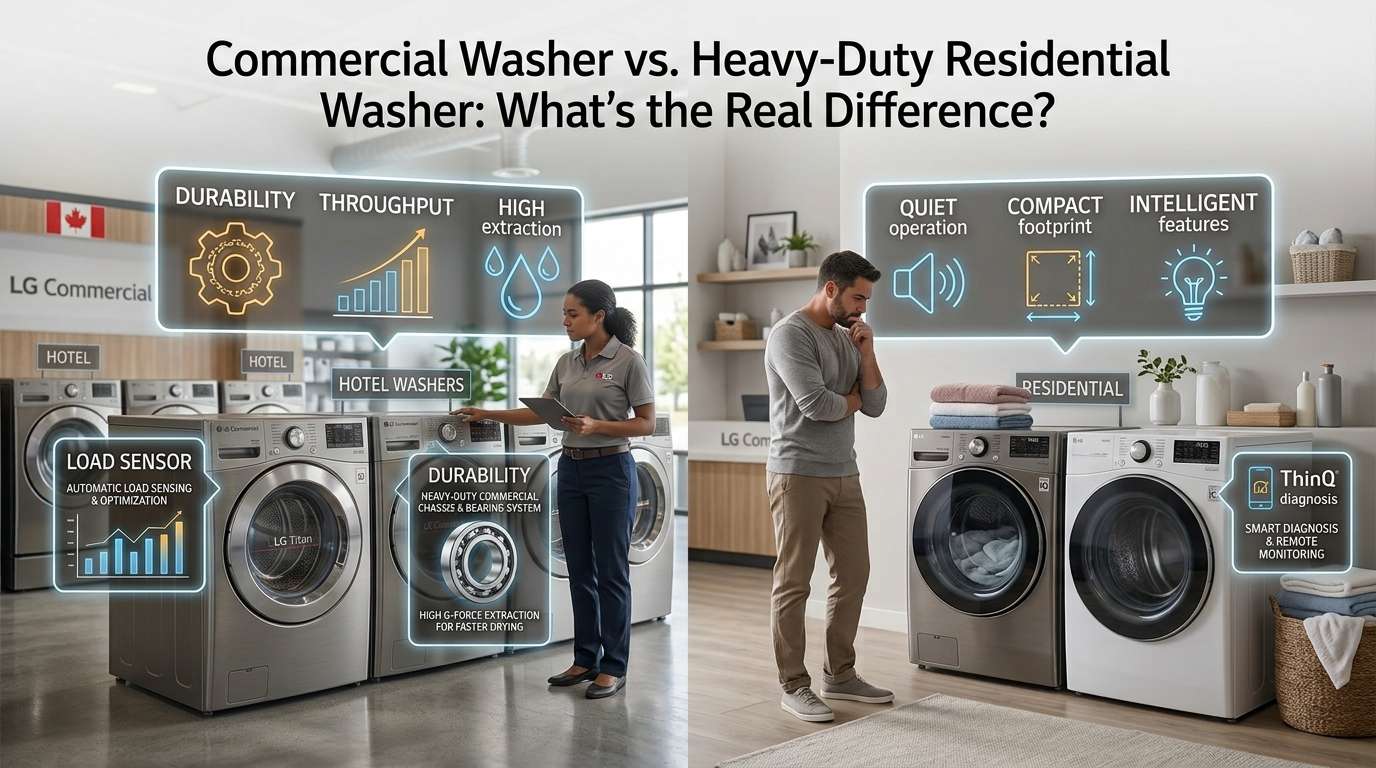
Commercial vs Residential Washer: 5 Costly Mistakes to Avoid
1. Ignoring the Duty Cycle
Every washer is engineered around an expected duty cycle: how many loads per day, and how many years of that. Residential machines, even heavy-duty ones, are designed for a handful of loads a week in a single household. Commercial washers are built for dozens of cycles a day, every day. Run a residential motor, bearings and suspension at commercial volume and they wear out far faster than their rating suggests.
2. Assuming the Warranty Will Cover Business Use
Residential appliance warranties commonly exclude commercial use. If a home washer fails in a hotel, laundromat or apartment laundry room, the manufacturer can deny the claim, and you absorb the whole repair or replacement. A commercial washer warranty is written around business use. Always confirm the exact terms for the model you’re considering.
3. Underestimating Capacity and Throughput
Commercial washers have larger drums specifically so a business can process more laundry per cycle. A residential machine can’t match that throughput, so you end up running many more cycles to do the same work. Those extra cycles accelerate wear on a machine that wasn’t designed for it, and they cost more in labour, water and electricity.
4. Judging by Sticker Price Instead of Total Cost
The cheaper machine is rarely the cheaper choice over a realistic multi-year horizon. Add up replacement frequency, repair bills, lost warranty coverage and downtime, and a true commercial washer usually wins. Our guide to commercial washer operating cost shows how to run that calculation for your own laundry room.
5. Trusting the “Heavy-Duty” Label
“Heavy-duty” and “extra-large capacity” describe a machine’s position within the residential lineup. They’re not a comparison to commercial-grade equipment. A heavy-duty residential washer is still engineered and tested against household usage standards. It’s a real upgrade for a big family, but it isn’t the same engineering category as a machine built to run all day in a business.
Commercial vs Residential Washer: Side-by-Side Comparison
| Heavy-duty residential | True commercial | |
|---|---|---|
| Upfront cost | Lower | Higher |
| Designed for | A few loads per week | Dozens of cycles per day |
| Expected life under business use | Significantly shorter | Built for years of daily cycles |
| Warranty for business use | Commonly excluded | Written for commercial use |
| Repair frequency under heavy use | Higher | Lower |
| Downtime cost | Higher | Lower |
The pattern in this table is consistent: a heavy-duty residential washer saves money on day one and gives some of it back later through shorter service life, uncovered repairs and lost uptime. For a household that trade-off is fine. For a business that depends on its laundry running every day, uptime and warranty coverage are usually worth more than the purchase-price saving, which is why most hotels, laundromats and multi-housing properties choose commercial equipment from the start.
What’s Different Inside a Commercial Washer
Look inside and the commercial vs residential washer gap is mostly about parts built to last:
- Motor and drive. Commercial machines use drive systems engineered for continuous operation, such as Inverter Direct Drive, which removes the belt and pulley entirely.
- Suspension and balancing. Heavier-duty damping and vibration sensing handle constant high-speed extraction without shaking the machine apart.
- Bearings and seals. Built to withstand far more total rotations and water cycles before failure.
- Cabinet and drum. Heavier construction copes with daily loading, unloading and wear from staff or customers.
- Payment and control options. Card, Coin and OPL configurations are available for laundromats, multi-housing and in-house laundries.
Commercial vs Residential Washer: When Does Each Make Sense?
A residential washer is the right tool for a household. It can also be a reasonable choice for a single rental unit or a very small operation that washes a few loads a week, provided the manufacturer’s warranty terms allow that use. Once you’re serving many users, charging per load, or running laundry as part of your daily operations, the equation flips. Volume, uptime and warranty coverage start to matter more than the purchase price, and that’s where a true commercial washer earns its place.
Five Questions to Settle the Decision
- How many loads will this machine run in a typical week?
- Will customers, tenants or guests use it, or only my own staff?
- Does the commercial washer warranty explicitly cover business use?
- What does an unplanned week of downtime cost my business?
- Do I need a payment system such as Card or Coin?
If the answers point to frequent use, shared access or costly downtime, the commercial vs residential washer question usually answers itself.
How Canadian Efficiency Rules Treat Commercial Washers
Efficiency regulation also treats the two categories separately. Natural Resources Canada publishes its efficiency regulations for household-style and commercial clothes washers as distinct product categories, which is another sign that these machines aren’t interchangeable. If your business runs washers for customers or tenants, it’s worth reading how those rules apply to you.
Warning Signs You’ve Outgrown a Residential Washer
If you’re weighing the commercial vs residential washer question while already running a home machine in a business, these signs suggest you’ve outgrown a heavy-duty residential washer:
- Repeated breakdowns, or repairs that never seem to hold.
- Guests, tenants or customers waiting because the machine can’t keep up.
- A machine running most hours of the day just to finish the daily workload.
- Drum noise, leaks or vibration that keep returning.
- A warranty claim that was refused because of business use.
Making the Switch to a Commercial Machine
If your business is running residential equipment and dealing with frequent breakdowns, denied warranty claims or a laundry room that can’t keep up, moving to true commercial equipment is usually the fix, and a commercial washer warranty is written for exactly this situation. It typically pays for itself faster than expected once you count reduced repairs and downtime.
Commercial vs Residential Washer: Frequently Asked Questions
Can I use a residential washer in my laundromat or apartment laundry room?
It’s not recommended. Residential machines aren’t designed for the cycle counts of shared laundry rooms, they typically lack payment systems, and their warranties commonly exclude commercial use.
Will using a residential washer in a business void the warranty?
Many residential warranties exclude commercial use, so a claim could be refused. Read the manufacturer’s terms carefully before you buy, compare them with a commercial washer warranty, and ask directly if you’re unsure.
How much more does a commercial washer cost?
The upfront price is higher and varies by model. A fairer comparison is total cost over several years, including repairs, downtime, utilities and warranty coverage.
Is a commercial washer harder to install?
Requirements vary by model. Check the spec sheet for electrical, water and drain needs, and have a qualified installer confirm your space is ready. Our team can point you to the right specifications.
Does a commercial washer clean better?
Not necessarily. The main differences are durability, capacity and throughput, plus features such as higher-temperature hygiene cycles on some models. The advantage is consistent performance at business volume.
Clinics in the GTA already run LG commercial machines: see our recent GTA installations.
Not Sure Which Machine Fits Your Business? Talk to Our Team
Tell us your business type, daily laundry volume and delivery province, and we’ll recommend the right commercial washer and dryer combination, with no obligation.
Not sure where to start? Read how to choose a commercial washer, see the real numbers in commercial washer operating cost, browse our LG commercial washers, or explore more commercial laundry equipment guides.
Want to see who you’d be working with? Visit our LG Commercial Laundry Canada profile on Google to see our location, contact details and customer reviews. If we’ve helped you, we’d truly appreciate a quick Google review. It helps other Canadian businesses find reliable commercial laundry equipment.