
Commercial dryer troubleshooting starts with one question: what is the machine actually doing wrong? A dryer that’s down for even a day can back up an entire laundry operation, and most failures trace back to a small number of components. Knowing which one to check first can save you a service call, or at least help you describe the problem accurately when you order a part.
Use this commercial dryer troubleshooting guide as a checklist. Below are the five most common LG commercial dryer problems, what usually causes each one, and the replacement parts involved.
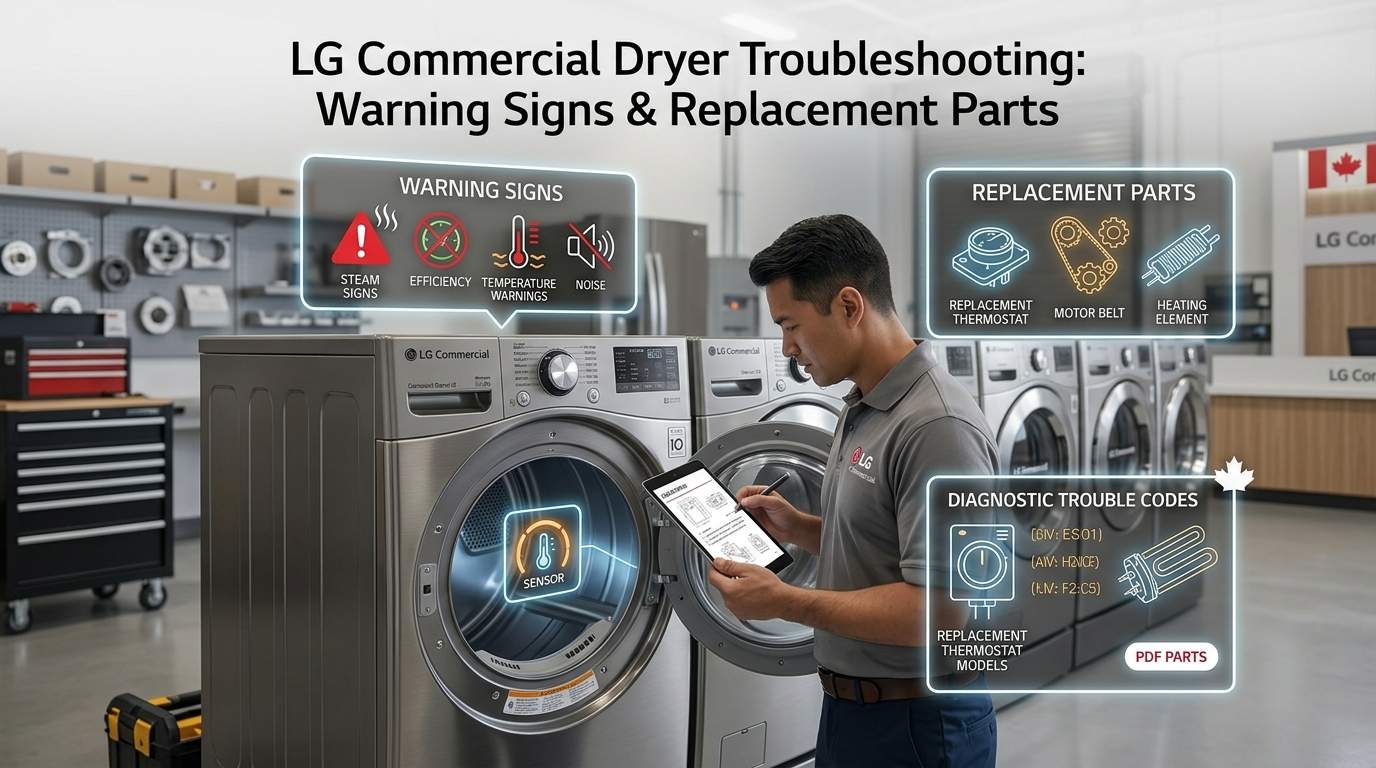
Commercial Dryer Troubleshooting: 5 Common Problems
1. Commercial Dryer Not Heating, or Taking Much Longer Than Usual
Most commercial dryer troubleshooting calls begin here. It’s the most common complaint, and it usually comes down to one of four things:
- Heating element (electric models) or gas burner assembly. If the drum turns but there’s no heat, the heating source itself has likely failed.
- Thermistor. This sensor monitors drying temperature and tells the control board when to cycle heat on and off. A faulty one can cause weak heat, overheating or cycles that end early.
- Thermostat. A safety component that cuts the heat if the dryer runs too hot. If it fails open, you get no heat even though everything else runs normally.
- Restricted airflow. Before you assume a part has failed, check the lint filter and exhaust duct. Blocked airflow causes long dry times on its own.
2. The Dryer Won’t Start
- Door switch. Commercial dryers won’t run unless the switch confirms the door is closed. A worn or misaligned switch is one of the most common failure points on high-usage machines.
- Main control board. If the display is dead or unresponsive, the board may need replacing.
- Power supply. Rule out the breaker and supply before blaming the machine.
3. Excess Noise or Vibration
Some noise is normal under heavy daily use, but a sudden change usually means a specific part has worn out:
- Drive belt. A rhythmic thumping or squealing often points here, and a failing belt can eventually stop the drum altogether.
- Drum rollers or bearings. A grinding or rumbling sound as the drum turns is the classic sign.
- Motor. A persistent high-pitched whine can indicate motor wear, especially on older units.
4. The Drum Isn’t Turning
If the dryer powers on, and may even produce heat, but the drum doesn’t rotate, check the drive belt first. A snapped belt is the most common cause of exactly this symptom. If the belt is intact, the motor itself may have failed.
5. The Hygiene or High-Temp Cycle Isn’t Reaching Temperature
If a cycle meant to eliminate bacteria consistently underperforms, look at the same components covered in problem 1. The thermistor and thermostat are exactly what regulate and confirm cycle temperature. Clogged airflow can also keep a dryer from reaching its target.
How to Diagnose a Dryer Problem Step by Step
Good commercial dryer troubleshooting works from the simplest, cheapest checks to the most expensive. Following this order avoids replacing a part that was never the problem:
- Confirm power and the breaker, and make sure the door is fully closed.
- Check the lint filter, then the exhaust duct and outdoor vent for blockage.
- Run a short cycle and note exactly what happens: no start, no heat, no drum rotation, or a specific noise.
- Match that symptom to the quick-reference table below and inspect the likely component.
- Check any error code on the display against your model’s manual before replacing anything.
- Replace one part at a time, so you know which one actually fixed the problem.
Commercial Dryer Troubleshooting Quick Reference
Use this table to match a symptom, such as a commercial dryer not heating or refusing to start, to the most likely cause and the commercial dryer parts worth inspecting first.
| Symptom | Most likely cause | Part to check |
|---|---|---|
| No heat | Failed heating source or temperature sensing | Heating element or burner, thermistor, thermostat |
| Very long dry times | Restricted airflow or a faulty sensor | Lint filter, exhaust duct, thermistor |
| Won’t start | Door not registering, power or board fault | Door switch, control board |
| Squealing or thumping | Worn belt or rollers | Drive belt, drum rollers |
| Grinding or rumbling | Worn bearings or rollers | Bearings, drum rollers |
| Drum won’t turn | Broken belt or failed motor | Drive belt, motor |
Before You Order Parts: Do a Lint and Airflow Check
Many problems that look like part failures are really airflow problems, and airflow is also a safety issue. The National Fire Protection Association notes that failure to clean is the leading cause of clothes dryer fires. Its tip sheet recommends cleaning the lint filter before or after every load and clearing the vent pipe at least once a year, or sooner if drying takes longer than normal. In a busy commercial setting, you’ll want to check the vent much more often than that.
Preventive Maintenance Checklist
The best commercial dryer troubleshooting is the kind you never have to do. A short routine goes a long way:
- Clean the lint filter after every cycle, not just when it looks full.
- Inspect and clear the exhaust duct on a regular schedule. Buildup is a leading cause of long dry times.
- Listen for any new noise and investigate immediately instead of waiting for a breakdown.
- Keep the door switch and seal free of lint, since a dirty switch can misreport the door as open.
- Don’t overload the drum. It strains the motor and belt and lengthens cycles.
DIY or Call a Technician?
Lint filters, door switches and belts are often replaceable with basic tools if you’re comfortable with appliance work. Heating elements, control boards and anything involving gas connections are best left to a qualified technician, both for safety and to avoid affecting your warranty.
When Commercial Dryer Troubleshooting Points to Replacement
Sometimes the honest answer from commercial dryer troubleshooting is that the machine has reached the end of its useful life. Repeated failures of different components, repair bills that keep climbing, and long waits for service are all signs it may be cheaper to replace than to keep repairing. Compare your repair history against the running costs of a newer model, and review our guide to commercial washer operating cost for the same cost logic applied to washers.
Find the Right LG Replacement Part
If you already know what failed, search our full range of LG commercial dryer parts by part number or description. Send us your dryer’s model number and the symptoms you’re seeing, and we’ll help you confirm the right component before you order.
Commercial Dryer Troubleshooting: Frequently Asked Questions
Why is my commercial dryer not heating?
When a commercial dryer is not heating, the usual suspects are the heating element or gas burner, the thermistor, the thermostat, or restricted airflow. Check the lint filter and exhaust duct first, since blocked airflow alone can cause weak heat and long dry times.
How often should I clean a commercial dryer’s lint filter and vent?
Clean the lint filter after every cycle. The NFPA recommends clearing the vent pipe at least once a year, or sooner if drying takes longer than normal. High-volume operations should inspect the vent far more often.
Can I do commercial dryer troubleshooting myself?
You can handle the basic checks: power, door closure, lint filter and vent. Anything involving electrical components or gas connections should go to a qualified technician for safety and to protect your warranty.
Why is my commercial dryer so loud?
Squealing or thumping usually points to a worn drive belt. Grinding or rumbling often means worn rollers or bearings, and a high-pitched whine can indicate motor wear. A sudden new noise is also worth checking for an object caught in the drum.
Where can I buy genuine LG commercial dryer parts in Canada?
Browse our LG commercial dryer parts catalog or contact us with your model and part number. We ship genuine parts across Canada.
How do I decide whether to repair or replace a dryer?
Look at the pattern. Repeated failures of different components, rising repair bills and long downtime all suggest replacement may cost less over time. Compare your repair history with the running cost of a newer model.
Based in the GTA? Genuine LG parts ship from our Mississauga warehouse: see our Toronto & GTA page.
Need Help With Commercial Dryer Troubleshooting? Talk to Our Team
If your dryer is down, every day costs you money. Send us your model number and symptoms, and we’ll help you identify the failing part and ship the right genuine LG replacement.
More help is on the way: read how to choose a commercial washer if you’re upgrading your washers too, see commercial washer operating cost for the numbers behind repair-or-replace decisions, or browse our commercial laundry equipment guides.
Want to see who you’d be working with? Visit our LG Commercial Laundry Canada profile on Google to see our location, contact details and customer reviews. If we’ve helped you, we’d truly appreciate a quick Google review. It helps other Canadian businesses find reliable commercial laundry equipment.